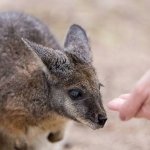
EASTERN GREY KANGAROO
Macropus giganteus
Eastern grey kangaroos are the second largest kangaroo, behind the red kangaroo, commonly found throughout eastern Australia. Their hind legs are large and powerful; they can leap distances of up to 9 metres in a single bound! Kangaroos can use their muscular tail as a fifth limb when they are moving slowly as well as for balance when hopping. A male eastern grey can weigh between 60-70kg and stand almost 2 meters tall, whereas females weigh around 40kg.
Kangaroos are considered nocturnal or crepuscular (most active at dusk & dawn) as they rest for most of the day.
WHAT THEY EAT
These animals are grazers feasting primarily on grasses, shrubbery and stringy bark. Capable of consuming large portions a day, large mobs can shape the landscapes they inhabit.
BREEDING
The eastern grey kangaroo breeds throughout the year with the females giving birth to one joey after a 36-day gestation period. The joey remains in the pouch until 9 months of age, then it will stay ‘at foot’ suckling for up to another 9 months until it’s completely independent. A female can have one joey in ‘gestation dormancy’ while she has one in the pouch and one at foot still suckling.